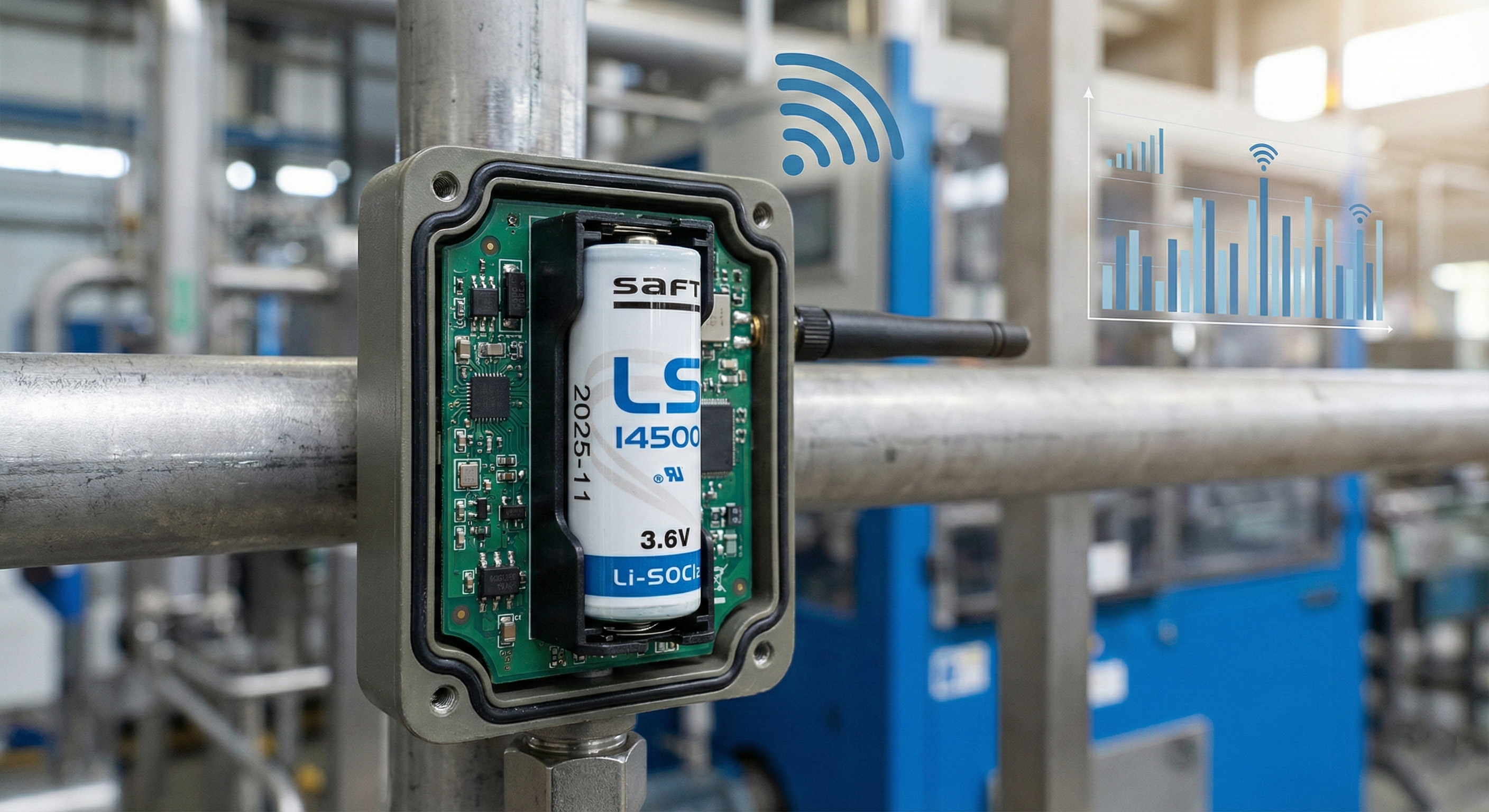
In remote areas, replacing a battery often costs more than the sensor itself. Discover how bobbin-type LiSOCl₂ technology coupled with hybrid capacitors solves the challenge of bidirectional wireless communication.
INTRODUCTION
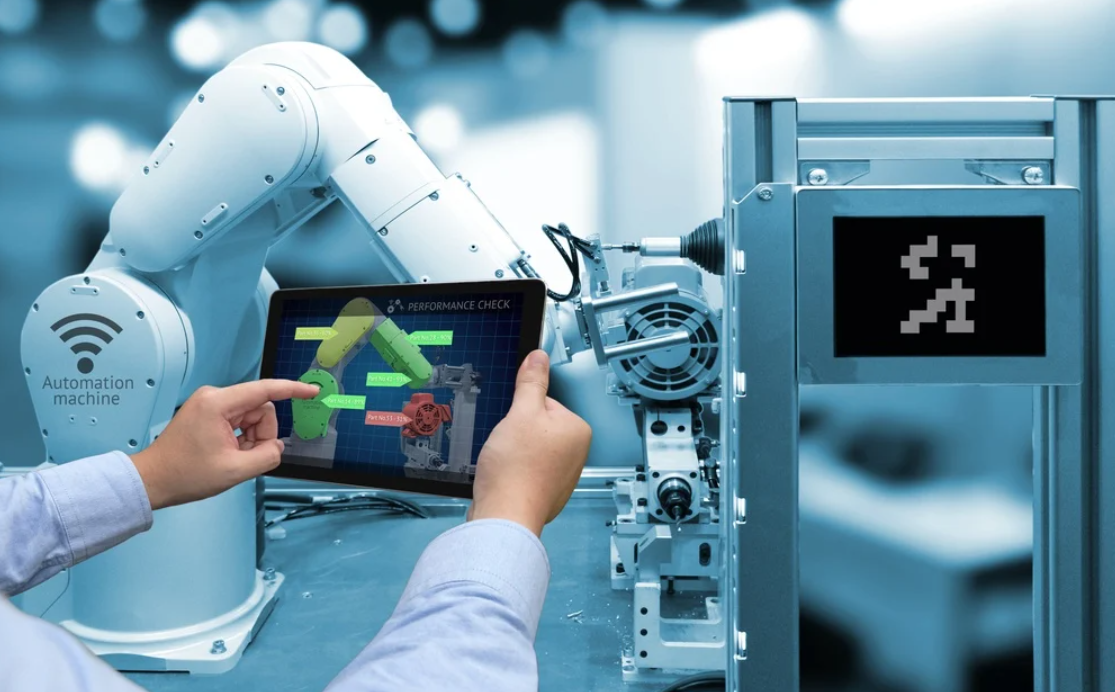
Optimizing Wireless IIoT Usage with Lithium Batteries. Wireless IIoT devices utilize bidirectional communications and require reliable power management solutions lasting several years. The use of long-life lithium batteries, such as LiSOCl₂ cells, can significantly reduce maintenance costs, especially in remote environments where replacement is expensive or impossible.The growth of IIoT in SCADA systems, M2M, predictive maintenance, industrial automation, or environmental monitoring has exploded the demand for battery-powered wireless sensors. These devices measure critical conditions (infrastructure, seismology, pipelines, tank levels, security, GPS/RFID assets) and must remain operational with maximum autonomy.
WASTEWATER MANAGEMENT APPLICATIONS
In the water, waste, transport, or energy sectors, remote monitoring solutions use AI sensors to detect anomalies, optimize maintenance, and strengthen cybersecurity. Tadiran bobbin-type LiSOCl₂ batteries ensure high longevity and stable power supply in these environments.Primary Batteries for Low-Power ApplicationsThe majority of IIoT sensors operate in standby mode with high pulse peaks. Several primary lithium chemistries exist (alkaline, LiFeS₂, LiMnO₂, LiSOCl₂, lithium-metal), each presenting specific advantages.Here is the comparison table:
| Primary Cell | LiSOCl₂ Bobbin-type + HLC | LiSOCl₂ Bobbin-type | Li-metal Oxide High Capacity | Li-metal Oxide High Power | LiFeS₂ | LiMnO₂ |
|---|---|---|---|---|---|---|
| Energy Density (Wh/kg) | 700 | 730 | 370 | 185 | 335 | 330 |
| Power | Very High | Low | Very High | Very High | High | Moderate |
| Voltage | 3.6–3.9 V | 3.6 V | 4.1 V | 4.1 V | 1.5 V | 3.0 V |
| Pulse Amplitude | Excellent | Low | High | Very High | Moderate | Moderate |
| Passivation | None | High | Very Low | None | Medium | Moderate |
| High Temp Perf. | Excellent | Average | Excellent | Excellent | Moderate | Average |
| Low Temp Perf. | Excellent | Average | Moderate | Excellent | Moderate | Poor |
| Operating Life | Excellent | Excellent | Excellent | Excellent | Moderate | Average |
| Self-Discharge Rate | Very Low | Very Low | Very Low | Very Low | Moderate | High |
| Operating Temp. | -55°C to 85°C | -80°C to 125°C | -45°C to 85°C | -45°C to 85°C | -20°C to 60°C | 0°C to 60°C |
Bobbin-type LiSOCl₂ batteries remain the benchmark for long-term projects thanks to their high energy density, wide temperature range, and self-discharge <1%/year.For high-pulse applications, hybrid solutions like PulsesPlus (LiSOCl₂ cell + HLC) ensure the power peaks that bobbin cells alone cannot provide.
IMPORTANCE OF VERY LOW SELF-DISCHARGE
Self-discharge can have more impact than the device's actual consumption. It depends on several factors: chemistry, material quality, cell design, and passivation control.LiSOCl₂ passivation creates a thin layer of LiCl temporarily reducing voltage upon wake-up. A poorly optimized cell can lose years of lifespan. High-end manufacturers use purified materials and controlled processes to stabilize this passivation.
CHALLENGES LINKED TO BIDIRECTIONAL COMMUNICATIONS
Wireless communications (WirelessHART, ZigBee, LoRa...) demand high pulses that standard bobbin cells cannot always provide. PulsesPlus technology meets this need thanks to a hybrid capacitor capable of releasing strong pulses.Supercapacitors, on the other hand, have significant limitations: low energy density, high self-discharge, short lifespan, cost of balancing circuits.
NOT ALL LISOCL₂ BATTERIES ARE EQUAL
Quality differences are major:- High-end: ~0.7%/year → up to 40 years lifespan.- Low-end: up to 3%/year → 30% capacity loss per decade. For critical projects, it is essential to request: - documented long-term tests - real field data - experience in similar conditions.A good selection ensures reliability, longevity, and cost reduction.
CONCLUSION
Choosing a high-quality lithium battery adapted to the energy profile of an IIoT device reduces maintenance costs, increases reliability, and ensures data continuity essential for modern industrial systems.